

I know nobody wants higher oil prices except for the people in the oil industry. Higher oil and energy prices are a very noticeable effect of the Federal Reserve’s inflationary rampage in recent years. Obviously, our government’s choice to initiate a war in the Persian Gulf has made things particularly bad for working-class households. But, with everyone spending more on oil products, forced to consume less, other businesses are crying in economic pain at all the lost business dollars that are missing from their customers too.
If the war in the Persian Gulf resumes in earnest, the expectations are high for devastation throughout most of the region including all our ally’s ability to pump, transport, and refine products for years to come. This could be globally catastrophic for everyone.
Oil does not cause a business cycle, booms, and recessions, but you can track business cycles by following oil prices: a master ingredient of the economic process. The boom phase where the Fed is injecting tons of money and credit usually sees oil prices rising and the bust phase shown in the shaded parts of the graph is when oil prices fall steeply.
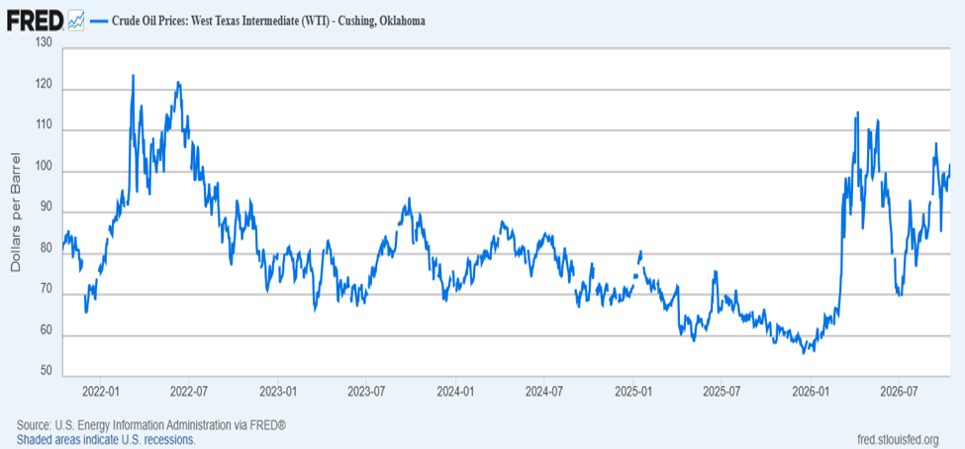
But let’s look at oil independently and microeconomically as current policies abroad and at home might indicate that oil prices remain stubbornly high for a long time and we could get the recessionary bust simultaneously.
The spike in oil prices from US military intervention is bad but it could have been worse, and I am arguing the case that we might have wanted it to be worse, economically and politically. (In anticipation of all the hate mail I will receive, I am leaving the country).
What has kept oil prices from going much higher, or much worse, has been political activity. The biggest of these political operations has been the releasing of strategic reserves. The US has led the way on nearly exhausting strategic stockpiles, and it risks permanently breaking the whole system which involves filling salt domes with oil. Other countries have also been releasing their stockpiles as well. Private business inventory levels are also critically low and things like refineries and pipelines require a continuous flow of input or are forced to shut down.
Governments have also been encouraging businesses to use up their reserves, their inventories, resulting in extremely low levels of oil inventories worldwide. All types of inventories are dangerously low.
Refinery capacity is also an issue because a big part of world refinery capacity is shut down in the Persian Gulf region or is under attack in Russia. In fact, President Trump’s recent flip-flop on Russian exports is questionable because Russia now lacks the capacity to supply the paltry one-half day per month supply of diesel fuel it has promised in return for all the US concessions.
Another issue with refinery capacity is that US and other refineries have been running at capacity levels for far too long without carrying out maintenance. That means all our refineries are in danger of collapse, explosions, and being out of service for a very long time.
There is much more to this problem, but let’s get to the point. How would higher oil prices early in the conflict be beneficial?
Immediately higher oil prices would send a shockwave through the economy in a good sense. Maybe a better analogy would be an “electric shock” that would certainly get everyone’s attention!
For producers it would mean so-called “windfall profits,” a phrase that gives the sense of random, unfair profits, but profits are always a signal to increase production—globally. Producers would certainly start preparing to turn on existing high-cost sources and developing existing known resources and even exploring for new resources. Refineries could allocate more resources to maintenance, productive capacity, and security.
I would suspect that there are many facilities related to production and refining that have been mothballed due to the hysterical environmental ideology and the policies that have been put in place to get their votes. The UK has shut down more than half of their capacity, along with many European countries, and there has been virtually no exploration or drilling in Europe for many years.
I can’t go into every aspect of how the market might respond to higher prices, but the key thing is that the unhampered supply side would have responded much more vigorously a long time ago and over the last 8 months.
Higher prices would also encourage more stockpiling and reduced consumption. Consumers are often slow to respond because it affects their whole life, like changing cars, taking public transit. You don’t reduce your fuel bill much by using DoorDash or Amazon because the fuel they buy to deliver gets built into the price. Fuel always has to be paid for. No one is giving it away for free. Consumers would already have had six months to adjust. Voters likewise would have had more time to register their anger with their “representatives.”
The big users of fuel would also have had more time to figure out the situation: Trucks, trains, tractors, and the airlines. They could have already bought more fuel-efficient fleets; they could have arranged for more storage capacity and developed strategies to save fuel that we are incapable of guessing—as they themselves might not know in advance of adversity.
I can hear your response: Well, if we have these political stockpiles, why don’t we use them? In answer, many people, including many experts, and even President Trump himself, have correctly argued that we should not have a strategic oil stockpile, that it is inherently costly and dangerous to make such a huge investment just to stick it back into a hole in the ground. Most importantly of all—and this is the point that President Trump has previously and vigorously argued—a political stockpile is subject to political manipulations and that politicians will use it for nefarious actions and to get reelected.
Economics argues the case that free market prices and free market policies are the best mechanism to prevent all these disruptions and to best soften the blow when they do occur. Government intervention inherently wastes resources for the future. Free markets automatically best allocates resources and conserves them for the future.

