According to some commentators, economic bubbles emerge because of inadequate demand and expanded capacity. Many believe that it is the exact opposite with AI—the expanded capacity is not enough to keep up with the demand. Hence, according to this logic, AI is not a bubble.
There is a tendency among many commentators to associate an economic boom with a healthy and growing economy. On the other hand, an economic bust is associated with economic weakness. Many commentators regard AI as a factor that will significantly strengthen the wealth-generation process. As a result, the chances for an economic bust appear to be very low.
Contrary to this way of thinking, an economic boom is not always genuine growth but often about the transfer of resources via expansionary monetary policies. This transfer is from wealth-generators towards activities that emerged due to expansionary monetary policies.
Once the central bank reverses its expansionary stance, the transfer of resources towards bubble activities that emerged because of easy money, inflation, and credit expansion slows or stops. This causes an economic bust. Hence, various activities that emerged due to credit expansion, including AI, will be starved of resources once the expansion slows or stops.
An expansionary monetary policy, through the lowering of interest rates via artificial increases in money supply, diverts resources to various projects that would not have otherwise emerged, at least not at the time and amounts they did. For instance, many projects, possibly even new AI ventures, that would not not have been considered economically profitable prior to the lowering of the interest rates through credit expansion now seem viable. Due to the artificial lowering of the interest rate, these projects now seem economically viable.
Prior to the lowering of the interest rates, the calculation of the net present value of various projects would have shown a negative figure. However, once credit expansion causes a decrease in interest rates, the calculated net present value of projects becomes positive. In the unhampered market, interest rates mirror individuals’ preferences towards consumption in the present versus consumption in the future. Individuals must necessarily have a higher preference for present consumption versus future consumption. According to Carl Menger:
To the extent that the maintenance of our lives depends on the satisfaction of our needs, guaranteeing the satisfaction of earlier needs must necessarily precede attention to later ones. And even where not our lives but merely our continuing well-being (above all our health) is dependent on command of a quantity of goods, the attainment of well-being in a nearer period is, as a rule, a prerequisite of wellbeing in a later period.
Also, according to Mises,
He who wants to live to see the later day, must first of all care for the preservation of his life in the intermediate period. Survival and appeasement of vital needs are thus requirements for the satisfaction of any wants in the remoter future.
This means that an individual will assign greater value to present goods over identical future goods. Whenever individuals decide to increase their future consumption over present consumption, this means that they have lowered their time preference. This will be manifested in the unhampered market by the lowering of the market interest rates.
As a rule, the central bank’s lowering of the interest rates via inflation actually disregards individuals’ time preferences. The lower interest rate is in response to central bank policy, not a genuine lowering of individual time preferences. In this sense, the lowering of interest rates is not accompanied by increases in individuals’ savings. Individuals have not decided to raise their future consumption and thus allocate savings for this task. This means that savings must be diverted to various bubble projects that emerged because of expansionary monetary policy.
Individuals employed in such activities that came about because of credit expansion and an artificial boom must be sustained. What enables their continued sustenance is continued inflation and the subsistence fund of genuine production and saving. But this cannot last forever.
Such projects might be impressive, such as artificial intelligence (AI), and they may even have emerged to a certain extent on a free market (at different times and in different proportions), however, these projects might not be profitable. What determines the affordability of these projects is the state of genuine market production, saving, capital investment, the pool of the subsistence fund, and how long inflation can continue as a policy.
The size of the subsistence fund constrains the affordability of the various impressive projects, such as AI. The attempt to disregard the fact that the subsistence fund might not be large enough to support various bubble projects could lead to economic impoverishment. For instance, take an individual that has just enough means to procure food and decides to buy a luxury car. As a result, this individual will endure hunger and is likely to weaken his health. Consequently, regardless of how impressive various projects may be, what determines whether these projects are realistically viable is the state of the subsistence fund.
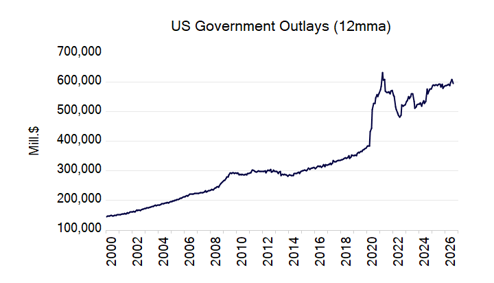
As things currently stand, the subsistence fund is in trouble. The key reason is the ever-growing government spending and the reckless monetary policy of the central bank. In addition to this, the imposition of tariffs further undermines this fund.
The sharp decline in the momentum of money supply since February 2021 is starting to hurt various activities that emerged on the back of the massive increase in the money supply momentum between August 2019 to February 2021. It is likely that the effect from these massive increases, which were historically unprecedented, is still dominating the economic scene. As time goes by, however, the effect from the massive decline in the momentum of money supply on economic activity is expected to assert itself. (Note that there is a time lag from changes in money supply and economic activity).
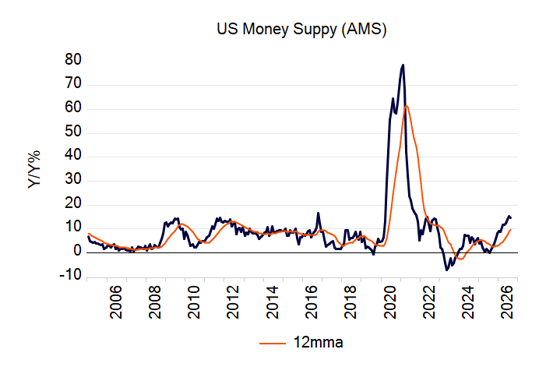
As a result, various bubbles are likely to crumble. The reason is because the diversion of savings to them will weaken on account of the decline in the money supply momentum. The likely deterioration in the subsistence fund is expected to undermine further the pace of economic activity. Consequently, various bubble activities will not have enough savings to survive.
It is likely that individuals are currently not wealthy enough to pursue activities such as AI to the extent that they are being pursued currently. Consequently, assessing these activities in terms of their possible strength in the months to come is futile. The issue here is not how good these activities are but the fact that they are misallocated and not affordable activities.
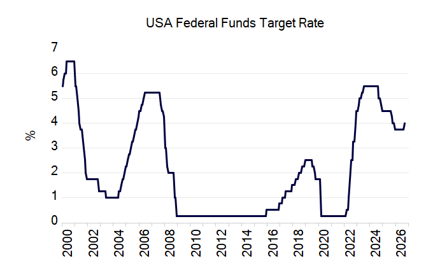
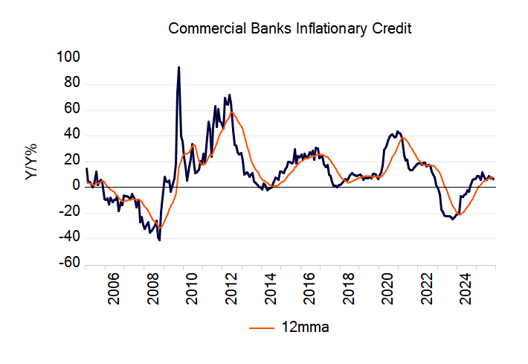
Now, if the central bank will aggressively lower interest rates and increase the money supply growth rate, this will make things much worse. Expansionary monetary policy is likely to undermine the subsistence fund further. We expect the banks’ inflationary lending to crumble in the months ahead. As a result, the growth rate in the money supply is likely to follow suit. This is expected to put more pressure on bubble activities.
To mitigate the crisis, what is required is to reduce or end the central bank’s tampering with financial markets and to severely curtail government outlays. This will arrest the pressure on the subsistence fund.
We associate a bubble activity with an expansionary monetary policy of the central bank. This type of policy gives rise to various undertakings that, in the absence of the expansionary monetary policy of the central bank, would not have emerged. Various projects, such as AI, have emerged on the back of the expansionary policy of the central bank might be of impressive nature, however, given the likely shrinking size of the subsistence fund, these projects are not affordable. So, regardless of how impressive these projects are, they are bubble activities and therefore are likely to burst.