The US hit a financial milestone a few days ago; the Federal debt reached $40 trillion. Some economists have argued that a large national debt isn’t necessarily problematic, and can even be beneficial. US GDP is also large, and as long as it grows at least as fast as growth in our national debt, we can finance this debt indefinitely.
Adding more debt could even improve economic conditions by stimulating growth and employment, in theory. How does this theory work? Additional government borrowing adds to total private spending (business investment spending and consumer spending) to increase aggregate demand. As an extra $10 billion of Federal borrowing circulates, it may raise GDP by 40 or 50 billion dollars; a fiscal multiplier effect of four or five. This is the reasoning behind President Biden ‘s spending and tax policies.
The simplistic notion of government borrowing leading to a fiscal stimulus multiplier effect is incomplete and misleading. Mass government borrowing raises interest rates, and higher interest rates cause private businesses to cut back on investment. That is, public borrowing can crowd out private investment. Mass government borrowing can also attract foreign investors who want to earn interest by investing in Treasury-bills. When foreign investors buy dollars to buy T-bills this makes the dollar stronger than would otherwise be the case. Increased foreign demand for T-bills means decreased demand for US exports, a decline in net exports, a trade deficit. A stronger dollar tends to increase imports, but with foreign transactions shifting towards financing the national debt we should not be surprised if the entire import-export sector of the US economy declines.
The next graph shows how trade grew relative to US GDP from 1965 to about 2009, but has declined since then.1
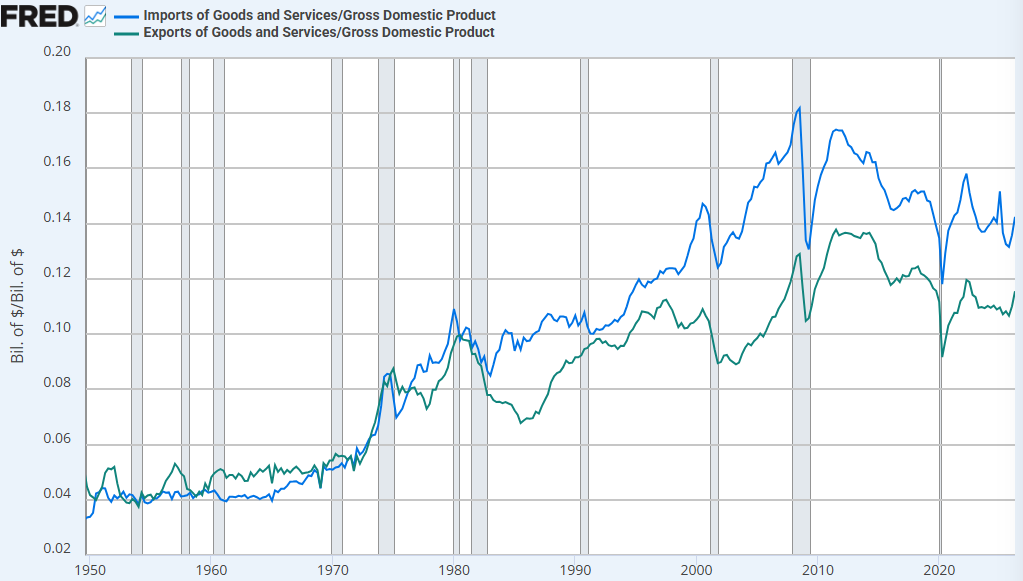
There was a surge in Federal debt held by foreigners from 2010 up to 2015- during which time the import-export sector peaked and began to fall, as seen in the graphs above and below. Foreign holdings of Federal debt didn’t increase from 2015-2018. Our import-export sector grew in 2016-2018. President Trump’s 2019-2020 borrowing spree did coincide with a sharp drop in exports.
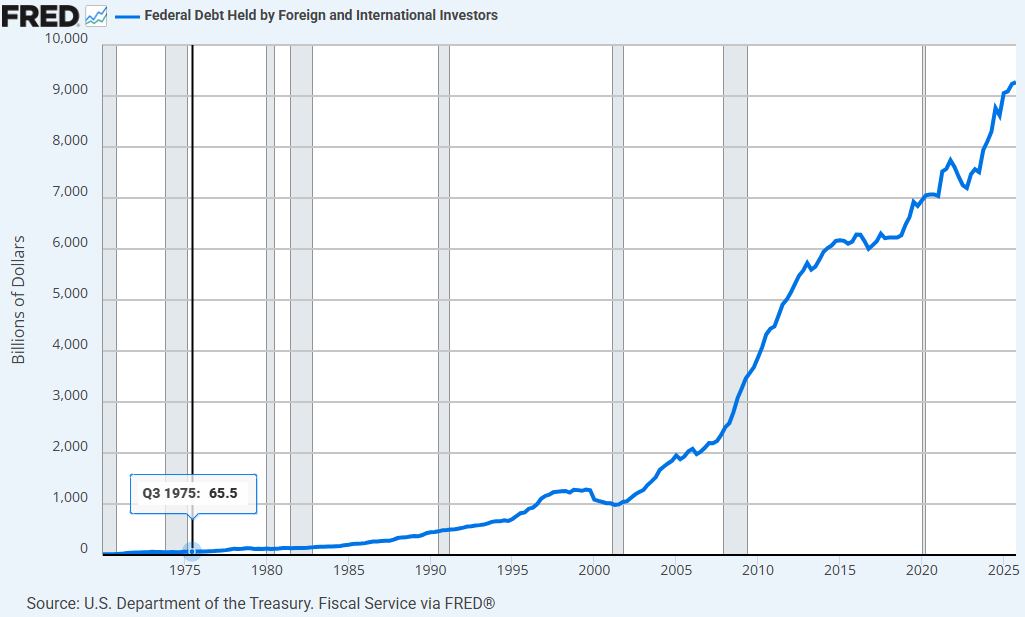
Exports did not fully recover during the Post Covid economic recovery, and following this recovery, the import-export sector of the US economy continued to decline. We should also note that US exports fell only slightly during 2025 and increased in 2026. This recent uptick in the foreign sector of the US economy followed D.O.G.E. spending cuts and a campaign against fraudulent spending and waste in entitlements.
Basic statistical testing supports the historical observations in the above paragraphs.
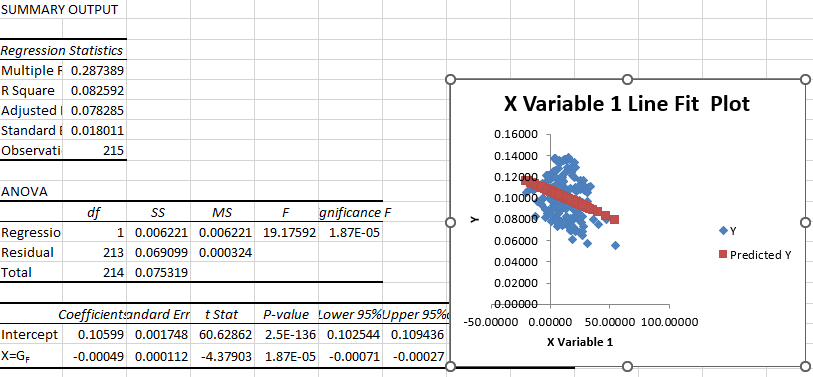
The ratio of US exports to our GDP is the dependent variable. Year over year changes in Federal debt held by foreigners is the independent variable, leading by one quarter. This test yields a modest inverse relationship, with outstanding statistical significance. When foreigners spend more of the dollars they earned in trade on US Treasury bills, they have fewer dollars left to spend on our exports.
The idea that public deficits crowd out investment or net exports is uncontroversial. The guru of Demand-Side economics, J.M. Keynes, grasped the crowding out concept, as did one of his leading disciples, James Tobin.2 Modern economists generally accept the proposition that a large volume of foreign trade weakens fiscal policy. Of course, the observations that I have made in this comment are not definitive. Full analysis of these issues would require statistical tests controlling for all other relevant factors. However, the trends in foreign lending and in trade that I’ve pointed out in the data suggest that our growing Federal debt has stifled US trade with the rest of the world.
Some of President Biden’s economic advisers told him that his massive spending bills would crowd out private investment, given that the economy was already approaching full employment when he first entered office. Biden later sneered at these advisers by pointing out that private investment remained strong, despite his piling up more debt. The economic theory of crowding out did not fail, President Biden’s advisors failed to recognize the changes in crowding out that Biden’s policies would end up causing. Crowding out issues are, of course, complicated. There is evidence that Biden’s borrowing spree, combined with his green industrial policies, raised mortgage rates and crowded out investment in homes. Biden’s fiscal recklessness crowded out private economic activity in new ways.
Conversely, President Trump’s D.O.G.E. policies have arguably done more to facilitate trade between the United States and the rest of the world than his tariff policies have done to restrict trade, albeit unintentionally. As previously noted, US international trade has bounced back a bit this year.
The evidence of a growing national debt stimulating economic activity is sketchy, almost nonexistent. The evidence of a growing national debt crowding out economic activity in the private sector is overwhelming. The issue of crowding out of private investment receives much attention. However, the surge in Federal debt that began with President Obama’s response to the Subprime Crisis appears to have had a large impact on the foreign sector of the US economy.
- 1
G.W. Bush’s unexpected and reckless spending increases did not help with US exports.
- 2
“If, for example, a Government employs 100,000 additional men on public works, and if the multiplier (as defined above) is 4, it is not safe to assume that aggregate employment will increase by 400,000. For the new policy may have adverse reactions on investment in other directions… The method of financing the policy and the increased working cash, required by the increased employment and the associated rise of prices, may have the effect of increasing the rate of interest and so retarding investment in other directions, unless the monetary authority takes steps to the contrary; whilst, at the same time, the increased cost of capital goods will reduce their marginal efficiency to the private investor, and this will require an actual fall in the rate of interest to offset it” J.M. Keynes, (1936) Ch. 10 Part III