As the US economy stumbles through rounds of inflation and self-inflicted crises, a look backward might be appropriate. To those that say we only should look to the future, the Federal Reserve’s history of the last two decades tells us that governmental and monetary authorities will do the wrong thing and make things worse. It is time to scrutinize the past.
In a recent article, I wrote about how the government almost always takes the wrong approach after a recession begins, which extends a recession and makes things worse, especially in the long run. Unfortunately, any politician or government agent (and especially a president) who does not openly intervene in the economy during a recession is accused of following a “do-nothing” strategy, which is tantamount to wanting people to starve to death.
As Murray Rothbard demonstrated in America’s Great Depression, Herbert Hoover intervened in the economy following the aftermath of the 1929 stock market crash more than any president had previously done. However, the typical academic, political, and media presentations of him almost unanimously portray him as a die-hard, free enterprise advocate who preferred “rugged individualism” instead of doing what was necessary to stop the economy from falling into depression. When historians and most economists are confronted with the fact that the Great Depression persisted throughout the 1930s despite the massive interventions of Franklin Roosevelt’s New Deal, they respond that the depression as a “natural” phenomenon that no one could have foreseen or stopped, with the New Deal seen as helping to mitigate the worst aspects of the depression.
One person who intervened mightily was Ben Bernanke, who was chairman of the Federal Reserve System in 2008 when financial markets melted down with the collapse of the Housing Bubble. Bernanke’s interventions, which were unprecedented at the time, involved having the Fed buy massive amounts of securities that went well beyond the central bank’s historical purchase of six-month treasury bills.
As the Fed became increasingly involved in the economy, the accolades for Bernanke followed. Time made him the 2009 Person Of the Year, declaring:
But Bernanke also knows the economy would be much, much worse if the Fed had not taken such extreme measures to stop the panic. There’s a vast difference between 10% and 25% unemployment, between anemic and negative growth. He wishes Americans understood that he helped save the irresponsible giants of Wall Street only to protect ordinary folks on Main Street. He knows better than anyone how financial crises spiral into global disasters, how the grass gets crushed when elephants fall. “We came very, very close to a depression. . . The markets were in anaphylactic shock,” he told TIME during one of three extended interviews. “I’m not happy with where we are, but it’s a lot better than where we could be.”
Certainly, Bernanke’s actions were “bold” in that they went well beyond where any Fed chairman had gone before, even beyond Alan Greenspan’s pushing the Federal Funds rate to one percent to counter the recessionary conditions that followed the collapse of the Tech Bubble in 2001, as well as to promise “liquidity” to Wall Street banks should there be a financial crisis, the infamous “Greenspan Put,” later to be called the “Greenspan-Bernanke Put.” As one can see from the Time quote, it is taken, frankly, as an article of faith that unless Bernanke had massively intervened the economy would have sunk to depression levels of unemployment—and stayed there indefinitely. Indeed, Newsweek called Bernanke “The Man Who Saved the Economy.”
To get a better picture of what Bernanke did to merit this praise, the diagram below (which I also used in my previous article) shows just how the Fed moved past its traditional role of simply purchasing T-bills on the secondary market.
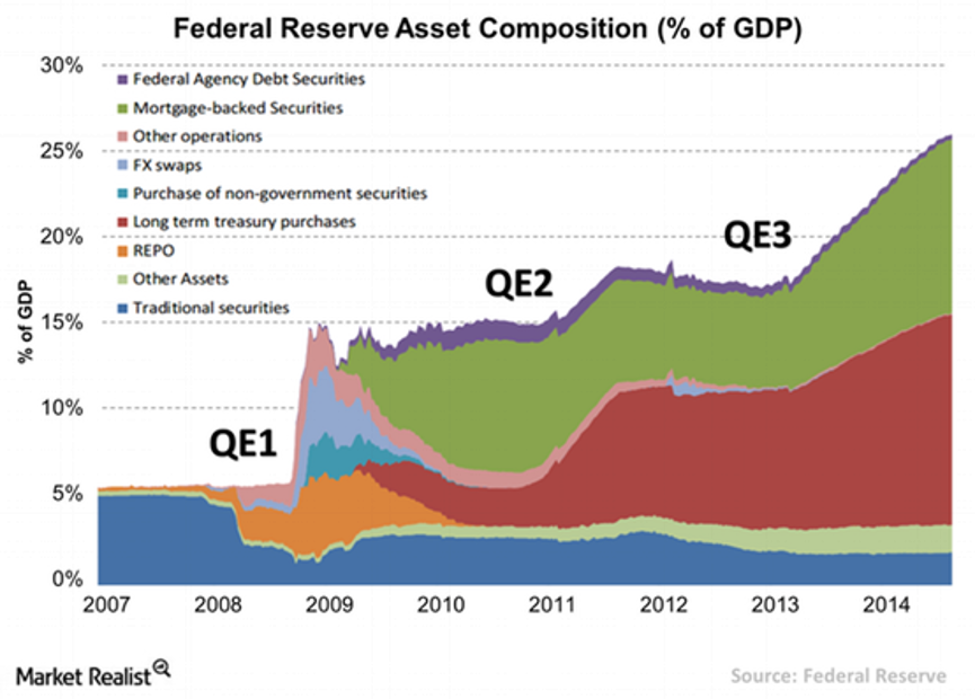
As the diagram shows, Bernanke’s Fed already had begun to move past the Fed’s traditional role of buying and selling six-month government T-bills even before the September 2008 Wall Street collapse, moving into things like repurchase agreements, which before had only been a very minor part of Fed operations. However, after the September disaster, the Fed’s checkbook became very active. The Fed began buying securities for assets that it had never done before, such as buying private stocks (the insurance company, AIG), mortgage securities (to help underwrite the “toxic assets” purchases to bail out the banks holding those securities and to keep mortgage money flowing into the housing industry), and long-term treasury securities in what the Fed called “Operation Twist” in which the Fed sold short-term government securities and purchased long-term securities in order to bring the yields of short-term and long-term bonds in closer alignment with one another.
As one can see, the Fed was not buying these assets to hold them because they had financial promise, but rather to artificially prop up their prices to prevent what the market would have done—relegate them to the investment trash piles. Instead of allowing the malinvestments that metastasized between 2001 and 2008 to be liquidated or diverted to other uses, as the market determined, Bernanke used the Fed’s checkbook to buy securities already declared worthless by the markets and pretend that they were valuable.
The diagram shows that, by the time President Barack Obama appointed Janet Yellen as Fed chairman in 2014, the Fed’s “Quantitative Easing” program had swelled the central bank’s “asset” holdings from five percent of US GDP to about 25 percent. Even though GDP is hardly an accurate picture of the economy or a nation’s economic well-being, nonetheless, these kinds of numbers would seem to be highly significant. Furthermore, given that such actions surely would have diminishing returns, it would seem that unless the government’s elected leaders and monetary authorities make the hard choice and wean the economy of these kinds of financial interventions, that it would take even more Fed asset purchases to bring about the same economic effects that these policies had around 2010.
As shown in the diagram below, that is exactly what happened. First, the Donald Trump interventions in 2020 in response to the government’s restrictive covid policies saw the Fed making massive purchases of long-term government securities and mortgage securities in order to flood the economy with new money, and then the Joe Biden administration brought security purchases up to 35 percent of the nation’s GDP. While those numbers have fallen since the 2022 peak, it is clear that the Fed is addicted to a Quantitative Easing program that never seems to end.
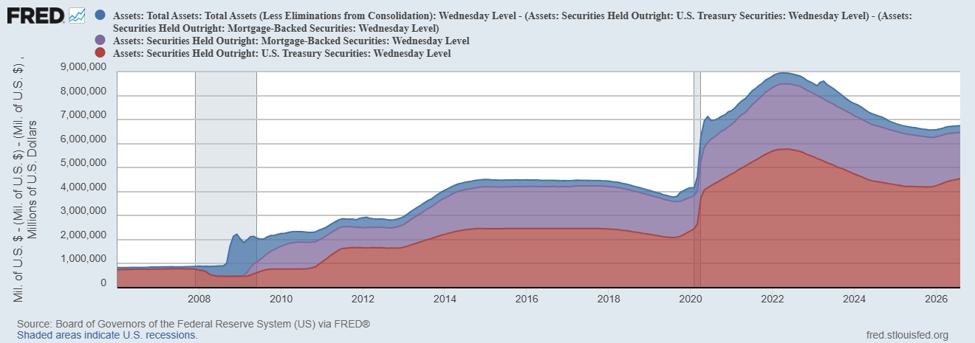
The US economy now is stuck in a very hard place. The Fed seems to have only one economic policy, and that is to print money as fast as possible and to “back” the new money with securities that have artificially high values, thanks to Fed strategies. Thanks to the current Fed continuing and adding to the financial edifice that Bernanke built, it is abundantly clear that the US economy is thoroughly addicted to easy money and artificially-inflated asset values.
This cannot continue indefinitely. As we already have seen, the Fed must be increasingly aggressive in continuing this asset buying spree to keep the same economic effects. At some point in the future, these measures will have little effect but will require the purchase of even more securities.
It is clear that Ben Bernanke did not “save” the US economy. While his massive interventions were hailed as keeping the economy from going into a depression, his real legacy has been more than a decade of a sluggish economy and inflation. Bernanke didn’t prevent a depression; instead, he prevented a real recovery and we have been paying for his bad choices ever since.