As the official federal debt hit the $40 trillion mark and attracted a lot of negative publicity, Treasury Secretary Scott Bessent tried to reassure CNBC’s Sara Eisen in an August 20 interview that there is nothing to worry about:
Well, yes, I mean, look, Sara, there’s nothing magic about the $40 trillion number. And we can grow our way out of that. So, but what we do want to signal is, I think that there’s been a lot of misinformation in terms of what’s going on with the deficit, what’s going on with the deficit to GDP. We actually had a fiscal consolidation for the calendar year 2025. We had, we are at about 5.7 percent of GDP. And one of the things that’s temporary here that’s influencing the deficit has been these tariff refunds. And we won’t have to do that again. . . . The other big item in the budget that we’re seeing is the hit that we’re taking from, to revenues for the immediate expensing of factories and of equipment and farm structures. And I think that, if people sit back and think, that’s not government spending. That is actually an investment in the future and we’re increasing the tax base. And that’s how, that is what measures the wealth of a nation, is the ability to increase after-tax return on capital. So we’re pulling back the, think of it as pulling back the slingshot here. We have a lot of potential energy that will turn into kinetic energy during this year, next year, as these factories come online.
While Republicans have long been chanting “voodoo economics” incantations (i.e., claiming that increased growth happens in spite of federal deficit surges caused by tax reductions, so tax revenues will eventually catch up to spending over the long run), Bessent’s remark does represent a new wrinkle on this theme. Here Bessent focuses attention on the ratio of the official budget deficit to GDP, as if the official budget is the only relevant factor affecting the future growth of total public debt and as if a short-run increase in GDP is a strongly positive indicator of the economy’s long-run ability to sustain increased taxes.
The most basic objection to Bessent’s argument (and indeed to the older versions of “supply-side” voodoo as well) is that it doesn’t make any fundamental difference in the physical quantity of capital goods if private savings are consumed by higher deficits instead of being consumed by higher taxes. Either way, the labor and natural resources that otherwise could have been devoted to increased net capital accumulation are instead diverted towards increased present consumption and/or increased governmental malinvestments. Giving a tax break to encourage greater investment without corresponding decreases in government spending is self-defeating, since increased deficits divert the additional savings away from private businesses towards the government and its clients and minions.
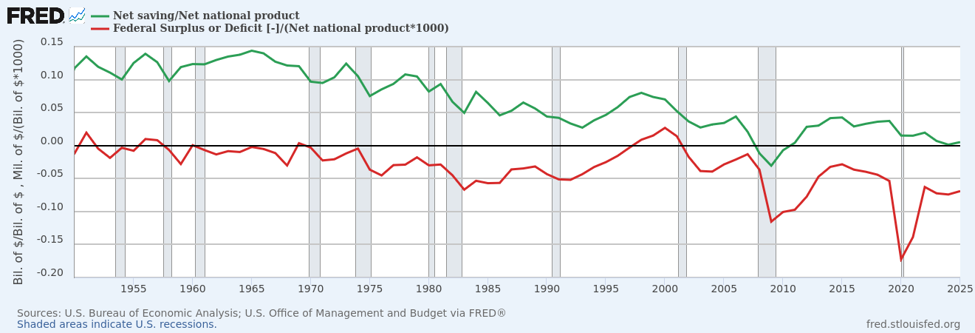
We can see through the Republican smoke and mirrors to visualize the relationship between deficits and net saving with a graph of historical data. Figure 1 shows these amounts as fractions of net national product (NNP, a measure of what was actually earned by Americans at home and abroad) over the past seventy-five years, with the green line representing net saving and the green line representing federal surpluses and deficits.
Figure 1: Net saving, federal surpluses/deficits as fractions of net national product, 1950–2025
Source: BEA and OMB via FRED®
During the first twenty-four years, net saving varied between ten percent to fifteen percent of NNP, while the federal budget was close to being balanced. However, net saving peaked in 1965, and has since declined to very nearly zero percent in the 2020s. This sixty-year decline in net saving coincides with the emergence of steadily worsening federal deficits, which started becoming particularly acute in the 1980s and early 1990s at around 5 percent of NNP (roughly comparable to the New Deal deficits of the 1930s). During Clinton’s two terms things turned around and the federal budget climbed all the way back to a small surplus, coinciding with a partial recovery of net saving.
Since the Clinton era the deficit situation has severely deteriorated, punctuated by sharp spikes during the 2008 financial crisis and during the 2020 covid lockdowns. It is in this fiscal morass that net saving has almost vanished. While Bessent can truthfully boast that net saving in 2025 was a little bit better than in 2024, keeping up this rate of improvement for three more years won’t even get net saving back to the level achieved under the first Trump administration in 2019.
Chronic deficits have canceled whatever successes Republicans have had otherwise in reducing tax rates on investors. Their failure since the Eisenhower administration to keep spending under control, in conjunction with the equally reckless fiscal policies of the Democrats, has had a catastrophic impact on America’s ability to keep increasing its stock of capital goods out of its own private thrift. While soaring deficits didn’t cause the entire decline of net saving over the past sixty years, they did account for roughly half of it.
The official debt figure as such isn’t even accurate as a measure of the problem, let alone magical, as $40 trillion gravely understates total federal obligations. This official figure does not include the net present value of the unfunded liabilities of the Social Security, Medicare, and federal employee trust funds, which the trustees (including Secretary Bessent) estimate will put the federal government a further $80 trillion in the hole in the absence of any growth-killing tax increases or political career-killing benefit cuts. The total liabilities of the federal government add up to at least $120 trillion; just servicing such an almost incomprehensible burden requires extremely powerful magic indeed, since no politician even dares acknowledge that two of the trust funds are set to go broke in the early 2030s, let alone come up with a plan to balance all the trust fund budgets.
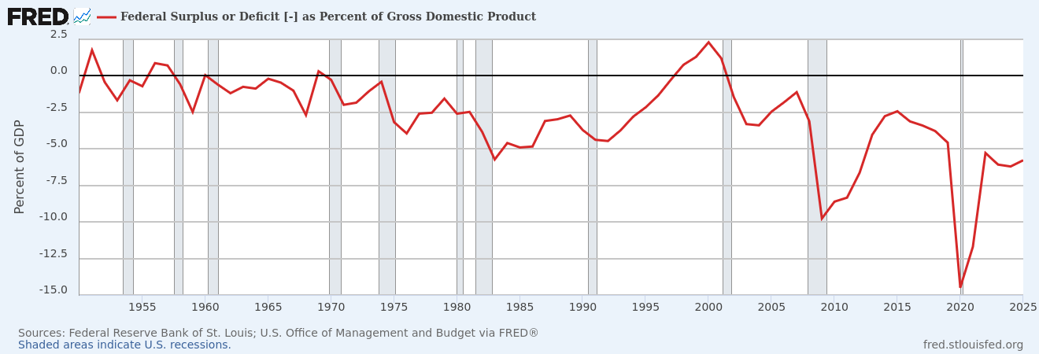
So what are we to make of Bessent’s contention that everything is fine because GDP is growing faster than deficits are? The deficit/GDP ratio referenced by Bessent (figure 2) did decrease from 6.2 percent in 2024 to 5.8 percent in 2025, but such a tiny improvement is barely noticeable when viewed over a seventy-five year perspective.
Figure 2: Federal surpluses/deficits as a fraction of GDP, 1950–2025
Source: BEA via FRED®
The deficit-GDP ratio in figure 2 looks very similar to the red line of figure 1, the main difference being that GDP is somewhat larger than NNP because it includes capital depreciation expenses (which makes “gross” metrics bigger than “net” metrics), offset slightly by the overseas earnings of Americans (which makes “national” metrics smaller than “domestic” metrics). GDP has grown slightly faster than NNP over this period, but it is NNP that is the better proxy of the income tax base, since depreciation expenses are not taxable while overseas income is taxable.
Admittedly Bessent overstating growth slightly by his preference for GDP over NNP is a minor issue, but it highlights a more fundamental methodological problem in his thinking. He starts by cherry-picking a popular metric to compare to the deficit metric and then extrapolates long-term trends from a single year’s changes in each metric. What he fails to do is to apply sound economic theories deduced from the incontrovertible fact of human purposefulness to the historical statistics, a priori theories which are necessary both for selecting the most relevant comparative metric and for correctly inferring what possible combinations of causal factors might account for observed changes. Moreover, extrapolating a sustained trend reversal from a single, small year-over-year improvement makes absolutely no sense; a credible time-series analysis of these data can only show a worsening budget trend.
The GDP growth illusion conjured up and widely touted by Trump, and Vance, as well as by Bessent depends heavily on wicked black magic of the monetary variety. The accelerating creation of fiat dollars out of thin air by the Federal Reserve and the creation of fractional reserve dollar deposits and other dollar-denominated substitutes out of thin air by the banking system—that is, accelerating inflation and faster inflation-caused price increases—are what temporarily boost GDP, what permanently increase trust fund obligations via statutory cost-of-living adjustments, and what fuel wasteful boom-bust cycles characterized during the bust phase by burgeoning deficits, severe declines of net saving due to intensified government interventions, and the writing off of massive quantities of malinvested capital.
This sort of monetary hocus-pocus never makes tax revenues catch up with soaring expenditures over the long run; inflation can “solve” the federal liabilities problem only by utterly destroying the purchasing power of the dollar and thereby making all dollar-denominated obligations worthless. Whatever one may think about the efficacy of the central bank’s monetary wizardry and the Treasury’s fiscal sorcery, none of their spell-casting, witchery’s brews, or prestidigitations are equivalent to private restraint of present consumption by Americans making more labor and natural resource inputs available for growing the physical quantities of sustainably-productive factories, equipment, and farm structures in America. The green line in figure 1 demonstrates that such growth has virtually halted; over the decades Republicans and Democrats alike have put a bipartisan hex on growth.